Friday, 25 April 2014

Meeting the neighbours


Let me tell you all about the new piece of land… I have to pinch myself really, because it is a whole acre and has a small stream running through it.
Ha! Coming from suburban London, I never thought I would be saying that to anybody…

The stream gully is partially planted in native NZ bush so about a third of the land is not usable if you were thinking of using it as a small-holding. But it has a gently-sloping north-facing aspect (good in the Southern Hemisphere) and we think it is interesting because it isn’t just a flat paddock. The lack of usable land seems to have put people off in the past, which is why it was in our price range, but we love the fact it is hilly and has a stream and has some character. Having some space around our new home is as important to us as having usable land.
The section has previously uncultivated good soil and it backs on to a paddock and a cemetery; there are bees next door and a lovely big oak tree. There is also an old laundry outbuilding.
The section is about 3 kilometres from the centre of Coromandel Town so we’ll continue to have good access to shops which is great if, like me, you are reasonably impetuous in your cooking and fairly disorganized in your planning.
This is the PLUS list by the way…

The MINUS list includes a few challenges: the section has a proliferation of weeds (thistle, blackberry, arum lily, couch grass and montbretia).
It is also adjacent to the main road between Coromandel and Colville so that doesn’t give us a lot of privacy, especially to the southwest. The prevailing wind is from this direction, so we may have to plant some kind of shelter-belt.
This open aspect includes a clear view of our neighbour to our east who, although charming, has quite a prominent property, which we will want to screen ourselves from a little. 
The other challenge about Coromandel Town as a place, and Top Town in particular (as the northern part of Coromandel Town has been known since the Gold Rush days) is the high rainfall (often over 2,000mm/year).


So that’s it for now… as the weeks unfold, I am sure I will have more to tell you about progress on our new section and plans for the new buildings that we hope will one day grace it, as well as seasonal stories and recipes.

Next-door view of paddocks and cows

The bee hives on the next-door property, adjacent to the fence line

Friday, 18 April 2014

Starting from Scratch

When I came to Coromandel from the UK, I wanted to leave behind traffic jams and career pressures and live in a different way. Over the last 10 years I have managed to build a new life for myself: a new country, a new relationship, a new child, a new career and a newly-built house, as well as a new way of living: more sustainably, more in tune with the seasons, more home-grown and produced food. 

But now I am ready for something else…

The opportunity presented itself to sell the house, and we, as a family, decided to buy a new piece of land and start again. Think blank canvas… as an artist, nothing is more exciting or scary than the chance to begin again.
I think I can take those life changes I have already made to a new level. I realise that this may not work out exactly as I am dreaming or expecting, but I am prepared to take a risk in order to strive towards my imagined wonderful new existence!


Growing some of our own food and managing the essentials of life (bread, beer, wine, jam, eggs) is so very satisfying. Our young child Jack, is with us on this journey, and there is much he can contribute as part of the team.

But I don’t want to preach or take myself too seriously. This is life lived simply and joyfully – the story of a new home and a new start with enjoyable detours on the way into making or doing things for ourselves: art and craft projects, photography, growing vegetables, curing bacon, making cheese, and a billion other things. 

So you can follow me on my journey or dip a toe into one or two things that you’ve never done before too…


Wednesday, 9 April 2014

Apple, Fig and Ginger Jam

In the orchard since January, we have been loving the waves of ripening fruit: plums, peaches, pears, nashis, apples, figs, feijoas and persimmons. If my boy, Jack, is hungry, then he runs outside to see what he can find...
I was in my friend Briar's kitchen the other day and we were talking about ways to preserve figs, as they only last a day or two in the orchard before the birds get them. She dug this recipe out of an old preserving book she had, but it had dried figs in it. We decided to try it with fresh figs, so here is my attempt. I upped the quantity of figs in relation to everything else. It came out well, jammy enough for toast, but also enough like stewed apple to have with ice-cream... yum! Try it for yourself...
I took the photos myself too, so please let me know if you think they are getting better - improving my food photography is one of my aims for 2014.

Apple, Fig and Ginger Jam


1.5kg cooking apples
650g fresh figs
juice of two lemons
2tsp ground ginger
700ml water
1kg sugar

Makes approx. 7 jars

1. Peel and core the apples. Roughly chop them and put them in a large saucepan with the figs, lemon juice and ginger. Pour over the water and bring to the boil.


2. Turn down the heat and cook for about half an hour, stirring regularly, until the mixture is well-reduced and thick. All the fruit should be well-cooked too.

3. Add the sugar, stir well and cook on a rolling boil until the jam is beginning to set. You will know the jam is ready when you can put a small spoonful on a plate, allow it to cool and ‘wrinkle’ it with your finger.


4. Pour the jam into heat-sterilised jars and seal while still hot. Always fill the jar as full as you can, and wipe thoroughly around the lid so you get a good seal.

(recipe source: Pickles & Preserves (Love Food) with minor changes)

Sunday, 23 March 2014

A gift from the sea...

When someone gives you a lovely fresh snapper, what do you do with it?
Well, you could make two large meals for a family of four, that’s what!

Whole Baked Snapper with Fresh Braised Vegetables and Herbs

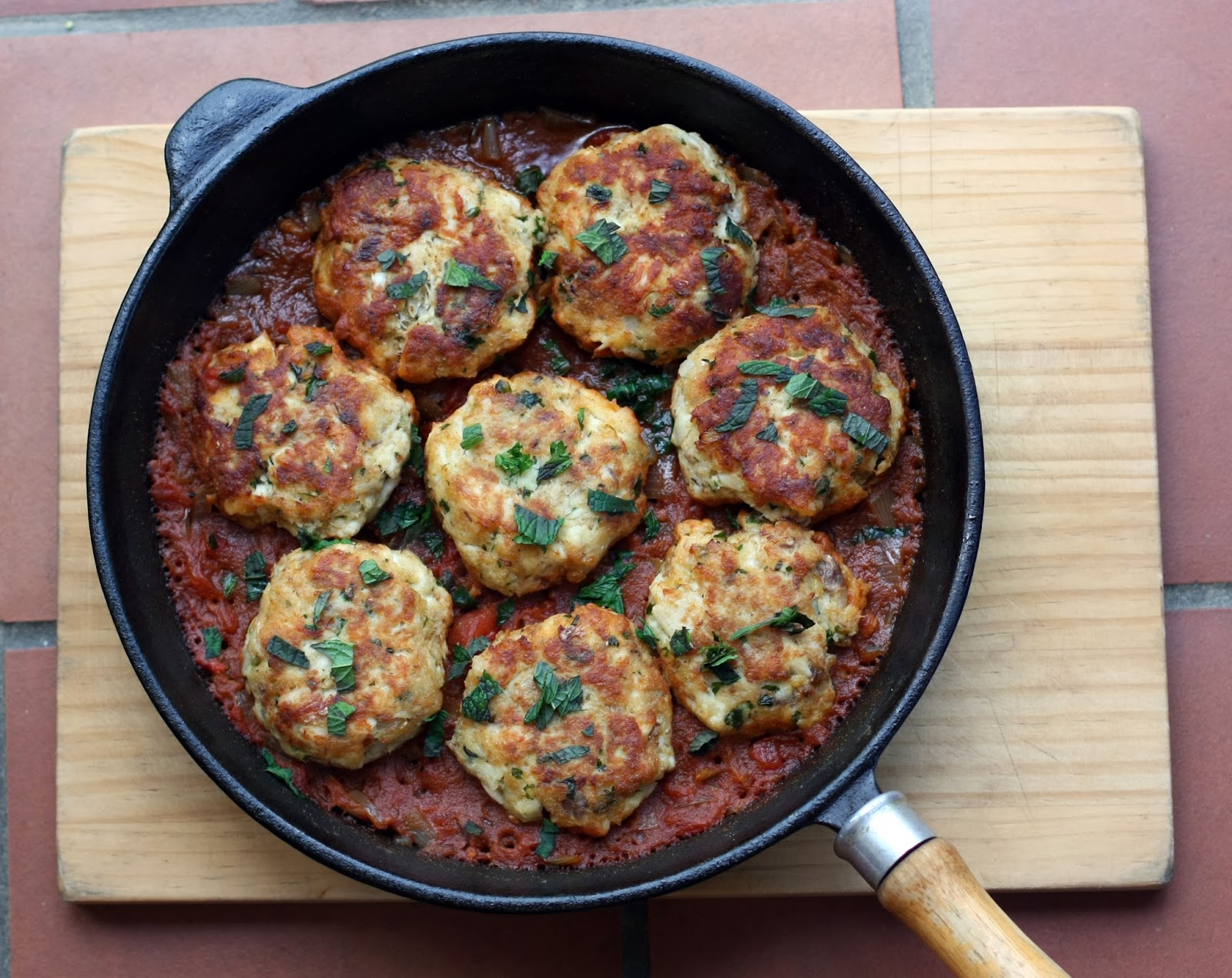
followed the next day by Fish Cakes in Tomato Sauce.

My snapper was a reasonably big one... measuring about 45cm from mouth to the 'v' of the tail, and weighing about 1.6kg.

Here's the first recipe:
Serves 4

1 snapper
1 onion
1 green capsicum
1 lemon
1 clove garlic
bunch fresh herbs: basil, parsley, bay and oregano
Extra virgin olive oil
Salt and freshly-ground black pepper
Potatoes for roasting

1. Preheat your oven to 220 degrees C. Gut and scale your fish, then wash and dry it thoroughly. 
2. Make a double layer of foil on the bottom of a roasting pan and make a bed of raw sliced onion, green capsicum, lemon and garlic for the fish. Stuff with fresh herbs and lay the fish on top. 
3. Drizzle extra virgin olive oil over the whole dish and season it. 
4. Bake it in the oven covered tightly in foil for about 45 mins. The best way to tell if it is cooked, is to poke a knife into the thickest part of the flesh and check it is white and firm all the way down to the bone. 
Note: I made little roast potatoes too, as I had the oven on, and served it drizzled in the juice from the veggies and fish. Delicious!

Here's the second recipe: 
Serves 4

3 slices bread
400g cooked white fish
1 onion, finely chopped
3 garlic cloves, crushed
bunch fresh herbs: basil, parsley or coriander, finely chopped
1tbsp ground cumin
2 eggs
Extra virgin olive oil
Salt and freshly-ground black pepper

4 small portions home-made tomato sauce (p27 of Coromandel Flavour)
Rice to accompany the fish cakes

1. Remove the fish from the bones of the cooked snapper and check for any bones. Break up into bite-sized pieces.
2. Make breadcrumbs out of three slices of bread. Sweat the finely-chopped onion in a little oil. Then place all the ingredients (apart from the extra virgin olive oil) in a bowl and stir together. Use your hands to form the mixture into approx. 8 fish cakes.
3. Find a frying pan with a lid, into which the cakes will just fit if they are quite tightly squeezed in. Fry the fish cakes on each side in the olive oil and then cook them for 10 minutes in the tomato sauce with the lid on. If the sauce looks too little, add a little bit of water around the cakes.
4. Serve with rice.